The usual sequence
12–24 monthsbefore systems are integrated- CloseReporting arrives by email and spreadsheet
- Year 1Debate a new ERP or a forced migration
- 12–24 monthsAn implementation while the thesis waits
- Before exitIntegration last, if at all
Integration is usually the last mile of a deal. Zeak makes it the first: connect every system each company runs, from ERP and CRM to spreadsheets, in weeks, with no rip-and-replace, then build what your value creation plan needs.
Time to portfolio visibility
Weeks
not months
after close, on existing systems. Not a quarter of spreadsheets.
Read-only diligence. Write-back only on approval.
Zeak reads before it acts. Nothing changes in a company’s systems without sign-off.
Download brochureWhy PE firms look at Zeak
In most hold periods, systems are debated for a year and integration waits for whatever budget is left at exit. Zeak reverses the order.
The usual sequence
12–24 monthsbefore systems are integratedWith Zeak
Integration firstconnected in weeks at most, often soonerAcross the deal lifecycle
Operational due diligence, post-acquisition integration, value creation, add-on integration and exit readiness, on the systems each company already runs.
01 / PRE-CLOSE DILIGENCE
Zeak connects read-only to the company’s ERP, CRM, quality, supplier and finance systems, and the spreadsheets in between. The same connections become your day-one integration.
02 / DAY-ONE INTEGRATION
Keep Dynamics 365, SAP, NetSuite or QuickBooks. Zeak connects them, unifies identity and data, and reconciles to the diligence baseline.
03 / VALUE CREATION
Pricing discipline, supplier consolidation, quality and new product introduction, built as apps and agents the company works in every day.
04 / ADD-ONS AND EXIT
Each add-on lands on the same platform. At exit, the buyer sees traceable data and a documented systems estate, not a migration project.
Search companies, suppliers, ordersFund viewPRE-CLOSE · KEYSTONE PACKAGING · SAP B1 · READ-ONLY
Connect anything
ERPs, CRMs, quality systems, spreadsheets, PDFs. Zeak connects every company where it is and gives the fund one view, straight from the source, with write-back only on approval.
See it on your portfolio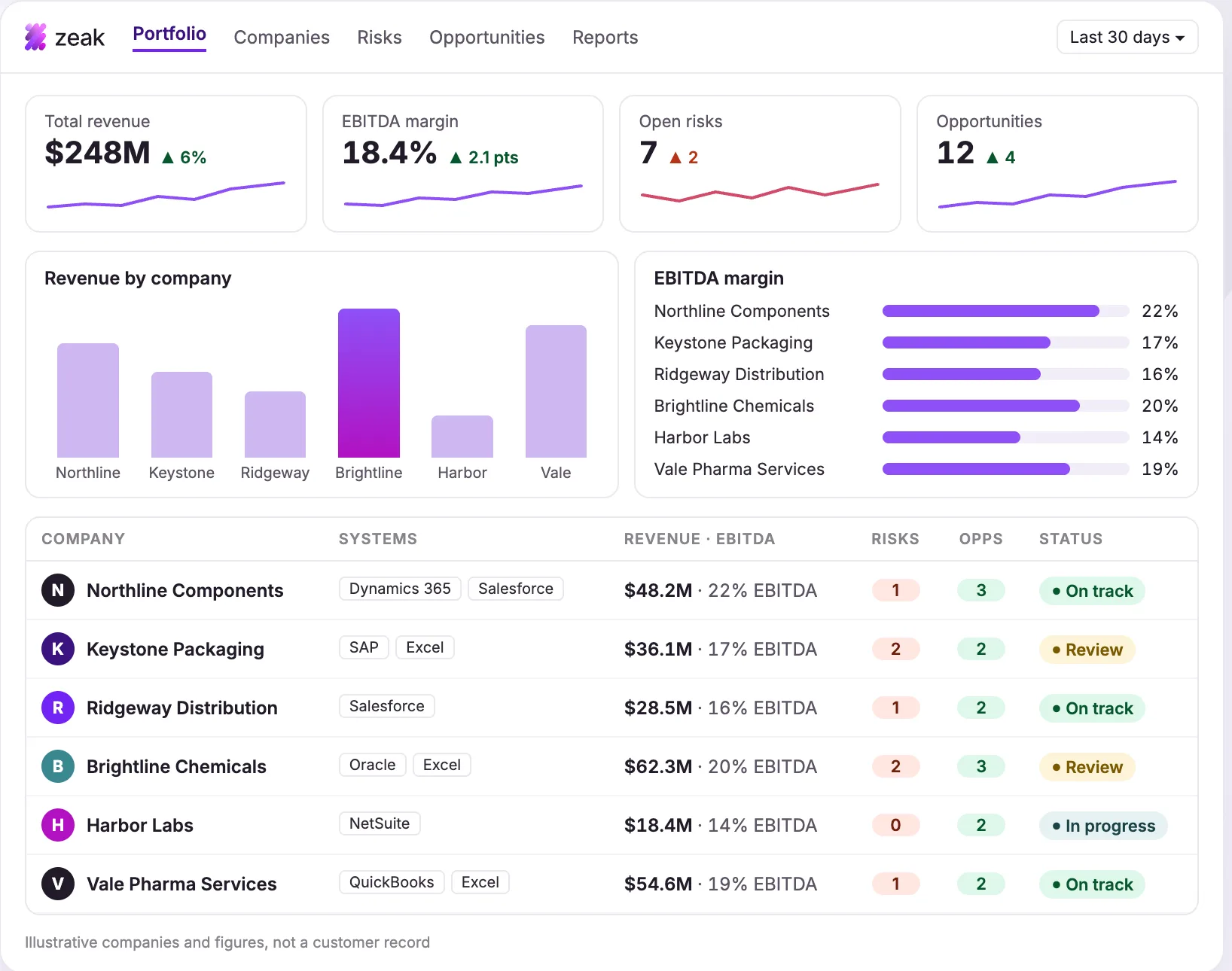







The most complex companies take weeks. Most are connected, visible and acting much sooner. Every add-on after the first inherits the playbook.
Done when: every system of record is connected and reconciled.
Done when: the fund reads monthly numbers from Zeak, not decks.
Done when: the first lever is measured on live data.
Done when: the company team owns it and the playbook is written.
Scoped per company; each step ends on an outcome, not a calendar date. Follows Zeak’s Scope → Define → Build → Validate → Launch & expand approach.
The platform
Portfolio tools report on systems. Zeak connects them, automates between them and runs the apps a business is missing, one workspace per company, in your cloud or theirs.
Every system stays standard; Zeak adds what is missing.
Pricing desks, plant dashboards and portals, built in weeks on the same platform.
Auditable workflows, with agents where they earn their place.
Security, DevOps and infrastructure come with the platform.
Role-based fund access, full audit trail, SOC 2 Type II and GDPR controls.
Built by founders with 25+ years each delivering SAP, Oracle and Microsoft Dynamics in pharma, chemicals, food and distribution, where systems can’t go dark and auditors read the logs.
The question every CFO asks
BI shows the numbers. Integration platforms move them. Re-platforming replaces everything and takes the hold period with it. Zeak wraps the systems a company already runs and becomes the layer people operate in.
| What a deal needs | BI and dashboards | Integration platform | Re-platform to one ERP | Zeak |
|---|---|---|---|---|
| See across companies on different systems | Dashboards only | Moves data, no view | After everyone migrates | One view from systems of record |
| Keep each company’s existing systems | Yes | Yes | No, replaces them | Wrap, don’t re-platform |
| Run operations: approvals, workflows, apps | No | No, pipes only | If the module exists | Apps, workflows and agents |
| Value inside the hold period | Visibility, not action | Plumbing, not outcomes | Usually after migration | Act on live data in weeks |
| Disruption to the company | Low | Medium | High | Low, nothing ripped out |
| What the buyer inherits at exit | Reports | Integrations to re-paper | A new core system | A working layer and documented estate |
Generalised characteristics of each category, not a claim about any specific product.
Ready on day one
Start where the thesis needs it. Each lever runs on the company’s own data and reports into the portfolio view.
Spend, risk and performance across companies: usually the first synergy and fastest EBITDA win in a roll-up.
Deviations, CAPA, audits and documents across every site, with the trail buyers ask for at exit.
Stage-gated launches with costing and approvals, so growth-thesis products don’t stall.
Schedules, output and yield on whatever systems each plant runs.
Pricing desks, rebate tracking, integration trackers, TSA exit checklists, 13-week cash. Built as the app, workflow or agent the company needs, in weeks.
Discuss your leverWho it’s for
Every deal type starts the same way: a conversation, then discovery.
Fold an acquisition into the parent without a forced ERP migration.
Discuss this deal typeStand up the operating layer so the TSA ends on time.
Discuss this deal typeOne playbook for every add-on, on QuickBooks, Excel or ten ERPs.
Discuss this deal typeTraceable data and a documented systems estate, 12–18 months before sale.
Discuss this deal typeReady for an upgrade? Evaluate your options while you plan for it, so you can minimize your overall spend.
Discuss this deal typeMany companies, entities and countries on different systems. One view, without forcing one ERP.
Discuss this deal typeWhat your IT and compliance diligence will find
Deployed in your cloud
Licensed as a platform, not per user: one agreement with the fund, deployed to each portfolio company and add-on.
Discovery comes first, so you see the opportunities and their economics before deciding anything.
You get: an honest view of fit and the next sensible step.
You get: the top 3–5 opportunities and the economics behind each.
You get: an integration brief and a 100-day systems plan; before close, a systems diligence readout.
NDA on request · Read-only access · Write-back only on approval · You decide at every step
With a conversation. If there is a fit, a discovery review of one company identifies the top opportunities and their economics, and you decide whether to go further.
Yes, read-only, with write-back only on approval. The same connections become the day-one integration.
Fast. The most complex companies take weeks; most are connected and visible much sooner, on the systems they already run.
A named owner, access to the systems being connected and a few hours a week during setup. No re-implementation, no new ERP to learn.
Yes. Each entity keeps its own systems and controls, and role-based access control (RBAC: roles and permissions) decides what each user sees and what they can do.
Start a conversation